
A Better Email Won’t Fix a Leaky Faucet
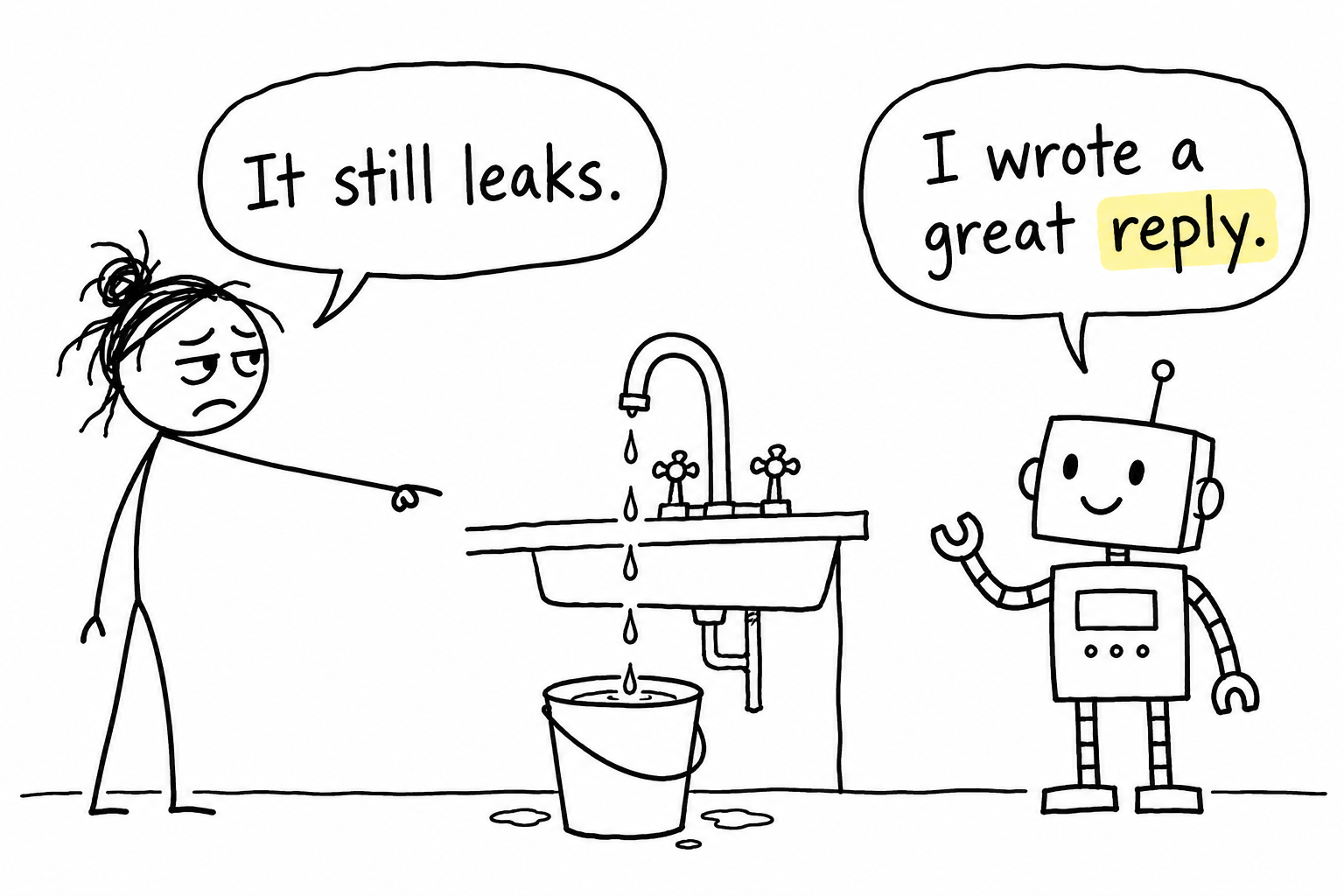
A tenant reports a leak. Within seconds, a beautifully written reply arrives: warm, reassuring, grammatically perfect.
The bucket under the sink keeps filling.
That little scene captures my problem with the AI pitch in property management. It is easy to demonstrate a better message. It is harder to demonstrate a better business.
The 2026 NARPM and AppFolio AI Opportunity Report offers a useful reality check. Its survey included 751 property management professionals at AI-using firms and 554 owners and investors. These are survey responses, not an independent audit of investment returns.
Three findings deserve a closer look.
The missing number is the result
Only 9% of surveyed managers had measured a quantifiable business improvement from AI. That does not mean the other 91% proved it useless. It means evidence is missing.
That distinction matters in both directions. Skeptics cannot turn an empty spreadsheet into proof of failure. Vendors cannot turn it into a success story, either.
Suppose a tool saves ten minutes on an owner update. Good. Now ask where those minutes went. Did someone follow up on an overdue repair? Did the team handle more properties without working late? Or did the saved time disappear into checking and rewriting the output?
Time saved is useful. Time saved after review, corrections, and software costs is a much more interesting number.
The person buying the promise may not carry the risk
The report finds 82% of owners comfortable with agentic AI, compared with 42% of managers. Owners’ comfort often rests on the assumption that their manager checks its work.
My reading: some of that apparent trust in software is really trust borrowed from a person.
Imagine an automated assistant tells a resident a repair is scheduled for Tuesday. Nobody has actually confirmed the contractor. The resident takes time off work. Tuesday comes and goes.
Who gets the angry call? The manager.
That is why hesitation can be sensible. A convincing demo does not tell you who will catch a false promise, how quickly they will catch it, or who will fix the mess afterward.
Before buying another assistant, I would want a clear answer to a very ordinary question: whose job gets bigger when this thing is wrong?
A hypothetical exit is not an eviction notice
Another striking result: 79% of owners said they would likely self-manage if AI could handle day-to-day operations. The condition matters. This is stated intent under a hypothetical scenario, not observed customer departures.
It is easy to want a cheaper alternative when the question assumes that alternative works.
Still, managers should take the question seriously. If your sales pitch is mostly answering messages and forwarding invoices, you make your service sound easy to replace. Explain the judgment behind the work: choosing a dependable contractor, recognizing a recurring problem, knowing when an apparently cheap repair will become expensive.
Those are things I would want a manager to make visible, with or without AI.
Real estate cannot rescue every AI promise
Here is my blunt take: I think the AI investment bubble will burst soon. That is my forecast, not a conclusion established by this survey.
The market has already supplied reasons for skepticism. Reuters reported on November 2 that the S&P 500 technology sector fell 6.8% in October, as concerns about spending and returns weighed on the AI trade. That is a broad technology measure, not proof that every company investing in AI is failing.
But inflated expectations eventually meet a bill. In that light, attempts to rescue a disappointing AI business case by attaching it to real estate look almost comical to me. Tie a balloon to a rental house and suddenly it is a property technology strategy.
That criticism is aimed at the sales logic. The survey does not establish that AppFolio, or any particular vendor, is deliberately trying to rescue a failed investment.
Nor would a stock market reckoning make every useful tool disappear. A product can earn its subscription fee while the grand story surrounding it falls apart.

Give the software a small job and a real test
My advice to a property manager would be boring on purpose. Pick one recurring problem. Record what happens today. Try the tool on a limited slice of work, and count the checking and cleanup as part of the cost.
For maintenance, measure time to resolution as well as time to first reply. For leasing, look beyond messages answered to appointments kept and leases signed. Keep a comparable group or period so a busy season does not get mistaken for a software breakthrough.
Then decide whether the result deserves more money.
Property management already has plenty of promises to keep. The next software purchase should help keep one.